


The title of this entry may seem far-fetched, however, we believe it is important to raise awareness of the serious problem that we are facing or, rather, that we are facing and must solve. We will give concrete figures on the Social Security Reserve Fund, and of the provisions made to date.
Current situation of the Social Security deficit
Since 2011 we have been suffering Social Security deficitWe are therefore obliged to make provisions for the “Pension Piggy Bank”. That was the year when the Reserve Fund had its record balance: 66,815 million. Who would have thought that only 5 years later, we would be in this situation. We can see for ourselves in this graphic illustrator:
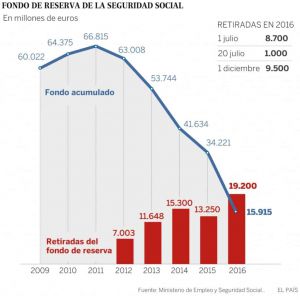
Pension Piggy Bank Withdrawals
We can see how, year after year, withdrawals have been increasing over time (except in 2014). The truth is that this is a worrying situation, mainly due to the fact that:
- In the year 19.2 billion has been made available in 2016 of €.
- The remaining balance of the Reserve Fund before the start of 2017 is less than 16 billion.
The time to pay the extra payments is when it is essential to have these billions available. In this line, as indicated by some political parties, next Christmas there won't be enough money to pay our pensioners the “Christmas bonus”.
A loan is used to pay the July bonus (Update 2018)
If we indicated in this original post, which dates from December 2016, that the payment of the extra payments was becoming complicated, the doubts have been confirmed. It has been necessary to resort to a loan granted by the Treasury to the Social Security in order to be able to pay the 9.6 million pensions for July.
The point is that the Pension Piggy Bank can no longer be counted on, with only €8 billion left in July 2018.
The question is: “and from now on what?”. In a recent post, we talked about several proposals that are on the government's table to try to raise more revenue. funds for Social Security. Although, of course, they are no guarantee of success.
It is up to us to prepare ourselves for retirement and to supplement the likely insufficient pension (either via the pension plan and/or savings schemes). If you would like us to help you improve yours, please contact us.